Inversion Tables vs. Inclined Spine Decompression: Why Low-Angle Traction Is Safer
Hanging upside down at 60°–90° spikes intraocular eye pressure and cranial blood flow while clamping ankles. Here is the physics of controlled 8°–35° inclined unloading on resonant pine.
1. The Gravity Paradox of Hanging Upside Down
For decades, steel inversion tables have been marketed as the default home back-stretching tool. The logic sounds simple: gravity compresses your spine all day, so hanging completely upside down should reverse it. Yet human cardiovascular and ocular physiology did not evolve for sustained head-down suspension.
Clinical ophthalmology studies consistently observe sharp rises in intraocular pressure (IOP) during full inversion, sometimes doubling baseline resting pressure within a minute. At the same time, venous return pools toward the head and systolic pressure climbs — making steep inversion unsuitable for adults with hypertension, glaucoma concerns, retinal issues, vertigo, or sinus pressure.
2. Ankle Clamping and Zero Spinal Support
Traditional inversion tables lock your ankles and suspend 100% of your torso weight through the talocrural joints, Achilles tendons, knees, and sacroiliac joints. Many back-pain sufferers abandon inversion tables simply because ankle discomfort forces them upright before their lower back ever relaxes.
Even worse, dangling freely without continuous back contact allows the lumbar spine to sag into hyperextension, causing posterior facet joints to press together and triggering defensive muscle guarding.
3. Controlled Low-Angle Physics (8° to 35°)
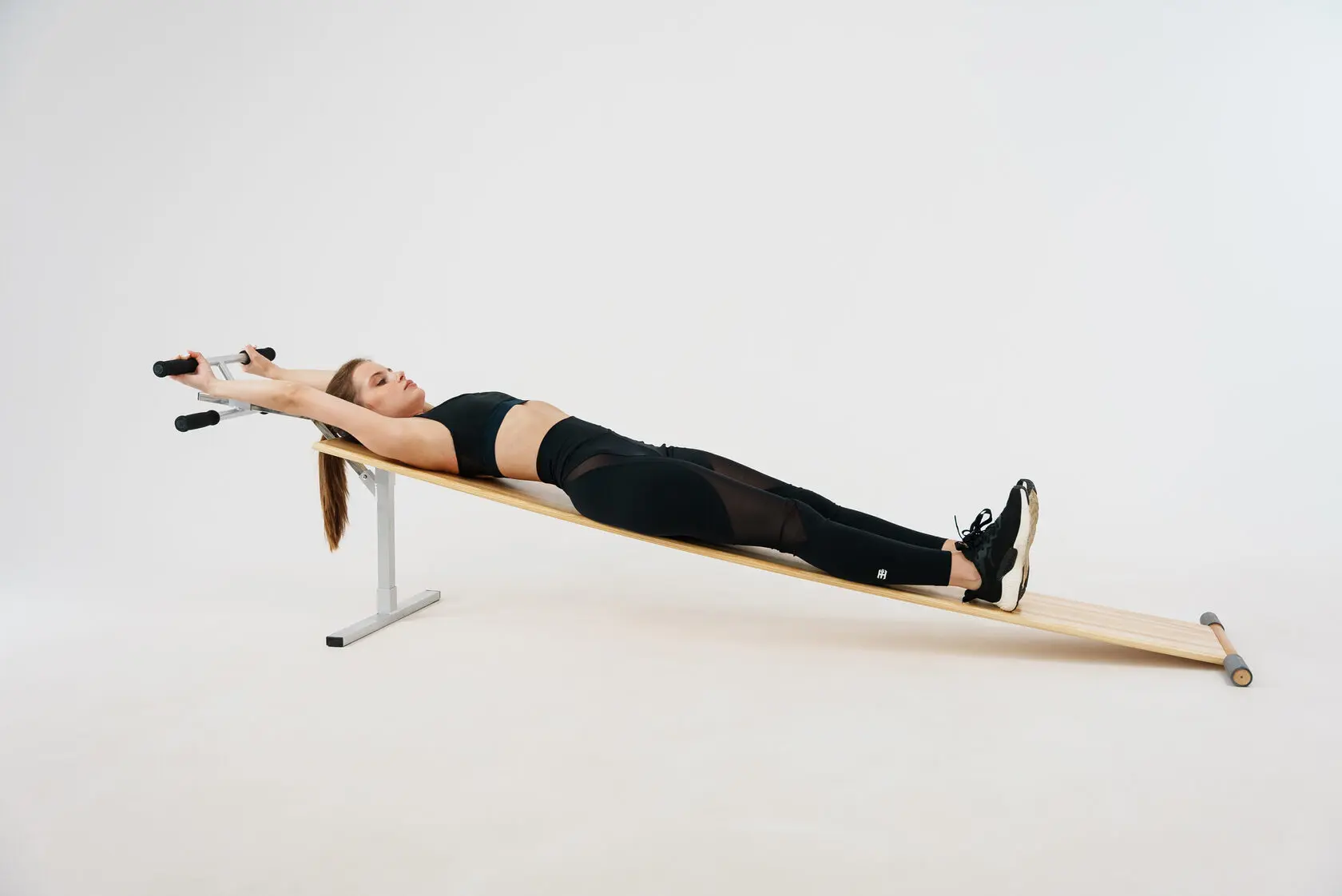
On the patented Evminov inclined board (US Patent 6,869,387 B2), your head stays elevated above your torso while your spine rests continuously along a multi-layer resonant Carpathian pine beam. Using standard inclined-plane mechanics (Net Force = Weight × sin θ − friction), a 180 lb adult at a gentle 18° angle experiences roughly 42 lbs of smooth axial unloading.
Because there is no ankle clamping and no blood rush to the head, your nervous system releases defensive back spasms within seconds, letting you perform gentle low-amplitude stabilizing movements that passive hanging cannot offer.
- Head stays above heart level — zero facial flushing or sinus surge.
- Zero ankle or knee clamping — hands rest comfortably on padded alloy carriage grips.
- Full-length pine flex cushions lumbar curves while preventing hyperextension.
- Folds flat to 2.4 inches against any wall instead of occupying 15+ sq ft of floor space.
4. Choosing the Right Alternative for Your Home
If you want consistent daily spinal decompression without dizzy spells, ankle pain, or a massive steel A-frame dominating your living room, an inclined wooden decompression board delivers finer force control, built-in cervical traction via the Glisson Loop, and a 20+ year heirloom timber lifespan.
Clinical & Biomechanical References
- Friberg TR, Weinreb RN. Ocular manifestations of gravity inversion. JAMA. 1985;253(12):1755-1757. (JAMA Ophthalmology / PubMed)
- Klatz RM et al. The effects of gravity inversion procedures on systemic blood pressure, intraocular pressure, and central retinal arterial pressure. J Am Osteopath Assoc. 1983. (JAOA Clinical Study)
Key Questions Answered
Is an inclined spine board safer than a Teeter inversion table for adults over 50?
Yes for most adults, because lying head-up at 8°–25° avoids upside-down cranial and eye pressure surges while eliminating ankle-clamp strain. Always consult your physician if you have cardiovascular or bone-density conditions.
How much traction force does a 15° to 20° incline create?
For a 170–200 lb adult, a 15°–20° incline generates approximately 30 to 55 lbs of smooth longitudinal unloading along the pine plane.